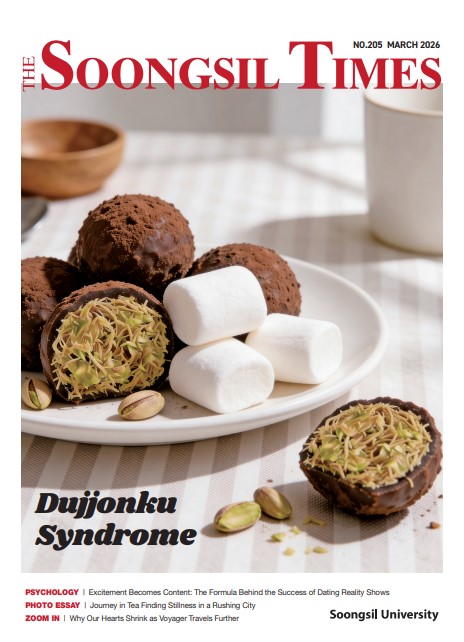
Currently, the Republic of Korea is occupied by the “Dubai Chewy Cookie” (Dujjonku). Even in sub-zero weather, many people wait for hours to purchase Dujjonku. Search volume for the keyword “Dujjonku” of delivery apps surged 25 times compared to October last year, when the trend was in the early days, and Naver keyword searches also reached 2.26 million by early January. A blood donation house in Mapo-gu, Seoul, gave Dujjonku as souvenirs instead of movie tickets, and then the center’s dedication rate soared 116% compared to the previous year. As the explosive interest in Dujjonku continued, new marketing has emerged in which Dujjonku are used as bait to sell products in completely different industries such as fashion platforms and movie theaters. These Dujjonku trends have evolved beyond mere fads into a social phenomenon, or “Dujjonku syndrome.” What is the Dujjonku that brought such an explosive craze?
Dujjonku is a hybrid dessert that has dominated the Korean dessert market since the end of 2025. The exterior is full of butter flavor, the texture is thick and wrapped in chewy marshmallows, and the interior is filled with fillings mixed with pistachio spreads. And the core of Dujjonku, and Middle Eastern thin cotton kadaif roasted in butter. Chocolate from Fix Dessert Chocolatier in Dubai, United Arab Emirates, is the origin. In December 2023, TikTok influencer Maria Behera’s video of a Dubai chocolate mukbang became viral worldwide, with over 125 million views. Since then, it was first introduced to Korea in the first half of 2024, causing open runs and shortages, but the heat seemed to cool down quickly in about six months. Then, the “Dujjonku” developed by a cafe in Gimpo-si, Gyeonggi-do, spread through SNS and revived splendidly. Dujjonku is a fusion dessert created by combining two existing Korean dessert trends, starting from regular customers’ requests to make “Jjoenduk cookie,” a dessert that was popular in the second half of 2024, a Dubai chocolate flavor.
The roots of K-desserts
The Korean dessert market has evolved beyond the realm of simple preference foods into a mirror that reflects the desires of the times and the media environment. This is a socio-psychological phenomenon that goes beyond mere curiosity. “FOMO(Fear of Missing Out) syndrome” is at the center of it. The fear of missing the flow and the feeling of alienation that I have not eaten alone stimulates anxiety that I am a person who is behind the trend. In addition, when the demand for a specific product increase, there is a “Bandwagon effect” that rides on the consumption of others, and the visual stimulation of SNS amplifies this effect worldwide. On top of that, the act of lining up to eat certain foods itself becomes a certification of a proof shot, playing a role in the “Vevlen effect” of showing off the scarcity that is hard to obtain and feeling satisfied. This, in turn, results in a circulating structure that strengthens the scarcity of the food. The history from the Joseon court refreshments that emphasized “integrity” to the transformation into SNS short-form desserts for “certification” is an important key to understanding the current Dubai syndrome. The roots of K-dessert can be found in the history of Jeonggwa(Korean traditional snack) that has been passed down since the Three Kingdoms period of Korea, especially in the “Gungjung Byeonggwa” of the Joseon royal family. Yakgwa, which used precious honey, oil, and grains, was regarded as a medicine, not just a snack, and Dasik, which features colorful patterns, is a prototype of Korean dessert that values the taste of viewing. Suksilgwa, made by cooking seasonal fruits, contains a naturalistic philosophy that saves the original taste of the ingredients. Drugs and fever, which have been revived as a grandmother trend, are a prime example of this reunion of traditional aesthetics and modern tastes.
Since the 2010s, the dessert market has entered a rapid short-term fashion cycle due to the spread of smartphones and the development of SNS. Rather than taste, “visual to show” and “sense” became the key criteria for consumption, and the fashion cycle was shortened to less than a year on average.
(1) 2013-2014: Honeycomb Ice Cream
It became the beginning of the “dessert queue culture” with an unconventional visual that put an entire honeycomb on top of the unique organic milk ice cream. However, in May 2014, a broadcast program raised suspicions about the paraffin composition of honeycomb, rapidly cooling consumer sentiment. Most of the 300 franchises nationwide closed in a year.
(2) 2016-2017: Taiwanese King Castella
The performance of the fluffy and huge castella being cut in front of your eyes provided a visual sense of fullness. Taiwan’s local taste can be enjoyed cheaply, leading to its explosive popularity with “costeffective desserts.” In 2017, when controversy over the excessive use of cooking oil in the manufacturing process was broadcast, consumers were turned away overnight. This incident remained a trauma that imprinted the risk of starting a single item on self-employed people.
(3) 2019: Black Sugar Bubble Tea
It is characterized by the visual of black sugar syrup flowing along the wall of the cup stimulated the desire for Instagram authentication. In the form of a combination of extreme sweetness and the chewy texture of tapioca pearls, a hybrid combination of “sweet taste + texture” proved to be a success formula.
(4) 2023: Tanghulu
The satisfying crunch of breaking a thin sugar coating has become a must-have item for teenagers by combining it with YouTube and TikTok Autonomous Sensory Meridian Response(ASMR) contents. It was popular enough to dominate the top search word for delivery apps in 2023, but it declined sharply due to health issues caused by excessive sugar intake, criticism of state audits, and the rise of the “Zero Sugar” trend.
It is Dujjonku that has emerged in this trend of dessert trends. According to Naver Data Lab, the trend of Dubai chocolate was short-lived, but it showed a strong buzz, recording much higher search volume than existing Tanghulu or Yoajung trends. And Dujjonku attracted higher interest than that. This is because it has overwhelmingly met the requirements of the Korean dessert market, “sense of taste” and “visual to show” amid the changing consumption environment.
How did Dujjonku Took Over Korea
Korean consumers tend to prefer complex textures over uniform ones. Dujjonku represents the peak of hybrid desserts, combining the chewy texture of cookie dough on the outside with the crisp crunch of kadaif pastry on the inside. While “chewiness” is not a universally favored texture across cultures, it holds a particular appeal in Korea. Traditional foods such as rice cakes, Injeolmi, and glutinous rice desserts, characterized around by chewy mouthfeel, have long-shaped Korean taste preferences and continue to influence them today. At the same time, crispy textures have also played an important role in Korean food culture, evident in traditional snacks like “Jeonbyeong,” “Gangjeong,” and “Yugwa.” The widely used expression “geotbasokchok(crispy on the outside, moist on the inside),” which became popular in the mid-2010s, clearly represents this Korean culinary sensibility. In this context. Dujjonku resonated by combining two contrasting textures, chewy and crispy, within a single dessert, precisely aligning with long-standing Korean texture preferences. The moist pistachio spread, crunchy kadaif, and chewy chocolate-marshmallow coating come together to create a sensory layered experience that resonates not only with Korean taste but also with a generation that values the pleasure of chewing and texture.
The visual appeal revealed with each bite, kadaif soaked in glossy pistachio spread, also plays a crucial role. Videos and photos capturing this moment spread rapidly on social media, accelerating the dessert’s rise in popularity. Since the rapid spread of social platforms, food has increasingly been evaluated not only by taste but by how instantly attractive it appears through a smartphone camera. At the same time, ASMR content emphasizing crunching sounds and breaking textures has gained popularity, expanding dessert consumption into a visual and auditory experience. In the age of algorithm-driven short-form content, desserts have gained the ideal conditions for viral spread. In an environment where creators must capture attention within seconds, visual and auditory stimuli that require little verbal explanation are especially powerful. Desserts are particularly well-suited to this format, transcending language and national borders with ease. The Dubai chocolate boom itself began on TikTok, where visuals of flowing pistachio cream, the crisp snap of kadaif, and vivid color contrasts positioned it as a “media-friendly dessert” optimized for short-form and ASMR content. Just as matcha’s vivid green once fueled the “matcha core” trend, today’s dessert trends are increasingly shaped by the intensity of audiovisual satisfaction rather than taste alone. The speed at which a single creator’s post can spark a global consumption trend underscores how individual media now play a central role in shaping worldwide food culture.
Anyone can make Dujjonku
The recent Dujjonkuboom in Korea stands apart from previous dessert trends in a clearly new way. Rather than revolving around a finished product from a single brand, this trend is built on an open, participatory structure in which recipes are freely shared, and anyone can take part. What began with café owners and small bakery operators quickly expanded to convenience stores, department stores, and major corporations, and spread into home-baking among ordinary consumers. People gathered with friends and family to make Dujjonku together, often sharing their own variations and recipes on social media. This phenomenon goes beyond simple online posting and reflects the emergence of a form of “hobby culture.”
Another notable aspect of the trend is the unprecedented number of spin-off products it has generated. Soon after Dujjonku gained popularity, a wide range of reinterpretations appeared, including Dubai-style ice cream, donuts, and tarts, as well as more unexpected items such as “Dubai tripe” and “Dubai Gimbap.” This level of expansion was made possible by the opensource nature of the recipe and the focus on core ingredients, such as pistachio and kadaif, rather than on a specific brand. As a result, both companies and individuals were able to participate easily, allowing new variations to emerge at remarkable speed. As online buzz grew rapidly, competition to launch Dubai-inspired products intensified across the market, with businesses from diverse sectors seeking to ride the trend. Amid an economic slowdown, Dujjonku has functioned as a lifeline for small business owners. In areas such as Seongsu-dong, a popular hotspot in Seoul, some independent cafés reported monthly sales exceeding 1 billion won after introducing Dujjonku, while others saw revenues increase by more than twenty times compared to the previous year.
The Dark Sides of Dujjonku
The explosive rise of Dujjonku brought fresh energy to the dessert market, quickly establishing it as a defining trend. However, as its popularity has grown, its darker side has also become more visible. Shortages of kadaif, a key ingredient, have sparked controversy, with criticism that large corporations are buying up raw materials. At the same time, some sellers have faced backlash for replacing kadaif with fried wheat noodles and selling the products at premium prices, an incident consumer have dubbed the “noodle scam.” More fundamentally, the boom has significantly disrupted the raw-ingredient market. Following the global success of Dubai chocolate, pistachio prices rose by more than 30 percent worldwide within a year. In Korea, import prices jumped by approximately 84 percent during the same period. California, the main supplier of pistachios to the Korean market, experienced poor harvests in 2025 due to unfavorable weather, with production falling by nearly 20 percent year on year. As global supply tightened, a surge in domestic demand made shortages and price increases difficult to avoid. The impact has gone beyond pistachios. Prices of cocoa powder, marshmallows, white chocolate, and even packaging materials have also increased, placing financial pressure on bakeries that do not sell Dujjonku at all. In a market where core ingredients are hard to secure even at higher prices, Dujjonku has shifted from a simple profit-making item to a key driver of customer traffic, and, in some cases, a factor in business survival. Industry experts warn that if the trend continues, rising costs may eventually lead to price increases across the wider bakery and confectionery sector.
Dujjonku Syndrome: Viral Craze or Steady Seller?
While it is common to gain popularity on social media as a food trend, it is rare for them to shake the global supply chain of the core ingredients like Dujjonku. The dessert has already spread to neighboring Japan, selling in cities such as Tokyo and Osaka, and is even being exported back to Dubai under the name “Korean Chewy Cookie.” In a sense, the Dubai chocolate that originated in the Middle East has been reinvented as a Korean dessert and returned to its place of origin.
However, like any dessert craze, Dujjonku is unlikely to remain a long-term trend. The speed at which people detect, and chase trends has increased, meaning scarcity is depleted even faster. Professor Jonghyun Park of the Department of Tourism & Food Service Industry at the Smart Convergence Graduate School, Kwangwoon University, explains, “In an algorithm-driven environment, the MZ generation is always searching for the next stimulus.” Within this constant demand for novelty, experts expect the Dujjonku craze to peak in the first half of this year and then enter a gradual decline.
Businesses that rely solely on a single trending dessert often face serious setbacks once the trend fades. Examples include King Castella or Tanghulu specialty stores. However, Dujjonku has spread in a different way, with existing bakeries and cafes have added it to their menus alongside regular offerings. If prices and ingredient supply stabilize, it could establish itself as a steady seller like Salted Bread or Mala Tang. Even if the dessert called Dujjonku disappears, “Dubai-style” desserts using pistachios and kadaif are likely to remain in various forms. Whether the Dujjonku craze ends as a short-lived trend or becomes a permanent fixture in the Korean dessert market remains to be seen.
Ihm Jae-young(News Editor)
pausoon@soongsil.ac.kr
Lee Eun-seo(ST Reporter)
les0404123@soongsil.ac.kr