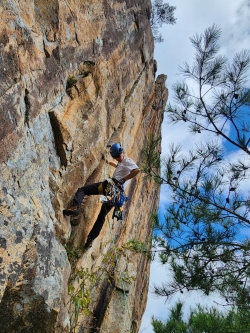
Amid the surge in sport climbing’s popularity, the raw appeal of natural rock climbing is finding a new spotlight. To delve into the philosophy of this classic discipline, we met with Lee Yu-chan (Physics ’25), President of the SSU Alpine Club, who shares how conquering the uncertainty of a natural cliffside offers a level of growth and composure that no indoor gym can replicate......... Ed
If asked to name one of the hottest sports among young people in South Korea today, sports climbing would undoubtedly be at the top of the list. This climbing boom in South Korea began to gain momentum following the emergence of Kim Ja-in, known as the “Queen of Sport Climbing.” Since then, with the adoption of sport climbing as an official event at the 2020 Tokyo Olympics, its popularity and public interest have soared.
What Exactly Is Sport Climbing?
Sport climbing is characterized by standardizing rock climbing to eliminate external environmental limitations and risk factors, allowing participants to enjoy competition against others. It consists of three disciplines: bouldering, lead and speed.
Bouldering involves conquering short, dynamic routes on artificial walls with the bouldering pad placed on the floor, and it has gained significant popularity as an indoor leisure sport. In contrast, lead is a discipline in which athletes aim to reach the highest point on an artificial wall of 15 meters or more within a time limit of 6 minutes. The athlete who reaches the highest point on the wall wins; if multiple athletes succeed in reaching the top, the one who has completed the climb in the fastest time is declared as the winner. Finally, speed is a discipline focused on reaching the top of a standardized 15-meter-high wall as quickly as possible. Since the holds and routes in speed climbing are internationally standardized, athletes perfect their movements through repetitive practice to continuously break records.
Rock Climbing, Which Receives Relatively Little Attention
Rock climbing refers to all forms of climbing on natural rock walls. Originating from Alpine ascents in the 18th century and evolving into alpinism—a philosophy that emphasizes the importance of the journey to the summit—this concept serves as the core ideology of rock climbing. While there are various forms of rock climbing, they all share one common trait: competition with oneself. Unlike sport climbing, rock climbing allows one to grow by going beyond personal limits and overcoming fear.
To find out what people who actually enjoy rock climbing think about it, Soongsil Times interviewed Lee Yu-chan (Physics ’25), president of the SSU Alpine Club.
1. Please give us a brief introduction of yourself.
I’m a sophomore in the Department of Physics, and my name is Lee Yu-chan. I’m 21 years old. I joined the Alpine Club last year, served as an executive in the second semester, and became president for the first semester of 2026. I also served as a student executive of the Korea Student Alpine Federation, an organization of university alpine clubs. I’ve been climbing indoors for six years and on rock walls for about four years. As for other experiences, I have been on one expedition to the Trans-lli Alatau Mountains in Kazakhstan. Since I love the mountains, my hobbies include climbing, hiking, and enjoying books and movies about mountains. I also enjoy collecting climbing gear and related records.
2. Could you briefly introduce natural rock climbing and its main climbing methods?
Let’s say that we’re climbing a 100-meter wall. Instead of climbing it all at once, we divide it into several sections, repeating the process of climbing one section and resting. This single section is called a pitch. When climbing, we have to use a rope, but if we use a 60-meter rope, we can’t use the entire length, so the maximum usable length is about 40 meters. Therefore, for a 100-meter climb, we would break it up into four or five sections. Climbing by linking multiple pitches in this way is called multi pitch climbing, while climbing a single pitch—a section of about 20 meters—and then descending is called single-pitch climbing. As these methods have evolved, they are now distinct disciplines within the category of rock climbing.
I’d also like to explain the concepts of lead climbing and following. Climbing is done with at least two people; the person who sets the rope and climbs first is the lead climber, and the person who follows along the rope is the follower. While the lead climber bears most of the risk, the follower faces almost no danger since they climb along a secured rope.
3. What is the unique joy that can only be experienced on rock walls?
At first, there was an appeal derived from the sheer beauty and technicality of the natural rock wall itself. It’s true that I was drawn to its uniqueness, which sets it apart from ordinary activities. However, when you push yourself to the limits on natural rock, there is “uncertainty.” When climbing, clipping into a bolt provides safety, but in the absence of bolts, you must place gear in cracks. If this gear is placed correctly, you’ll be safe even if you fall, but if not, it can be dangerous. That’s why you have to make constant judgments every moment. So, there’s a sense of joy that comes from controlling and overcoming this uncertainty. Also, while sport climbing involves hanging for short periods, rock climbing takes a long time, so it feels like I’m testing my limits.
4. How does the feeling of accomplishment differ from an indoor or artificial climbing gym?
Unlike bouldering, route-finding on natural rock requires a lot of preparation. If you want to succeed on your first attempt, you need to study climbing guidebooks and other climbers’ reports. Plus, since various conditions like the weather have to align, the sense of accomplishment is truly rewarding.
5. If there are experienced climbers who hesitate because they perceive rock climbing as dangerous or difficult, what advice would you give them?
I really hope they’ll just come and try it once. You can only know whether you like natural rock climbing or not by experiencing it yourself.
Natural rock climbing is a great experience that allows you to grow by continuously testing your limits. “When I have no choice but to choose a dangerous route, I instinctively feel fear; but once I’ve decided that I must conquer that route no matter what, I face the danger without hesitation. The first few moves are easy to make boldly, but soon a cool composure returns.”—Jean Coste, from The Mind of an Alpinist.
Lee Youn-jae (ST Cub-Reporter)
youn06@soongsil.ac.kr