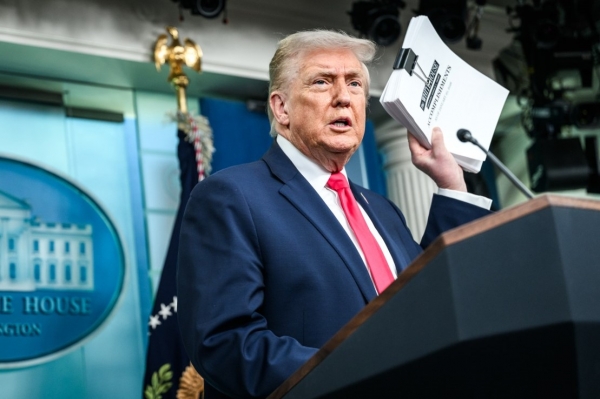
On January 20, 2025, U.S. local time, Donald John Trump, having successfully returned to power after a break, began his second administration. Contrary to expectations that he would govern with a deeper understanding of the importance of institutions and political consensus, based on his first-term experience, Trumpism has reemerged in a more intensified form. In particular, as high tariffs and tough foreign policy stance resurface, Trumpism is emerging as a major variable in international politics.
Definition of Trumpism
Trumpism is defined as Donald John Trump’s political style and mindset, along with the phenomenon of popular support that has formed around it. It is characterized by the following four key features:
Key Features of Trumpism
1. Strengthening Executive Authority
Trumpism tends to strengthen executive authority. This is remarkable in the active use of executive orders, conflicts with the judiciary and congress, strengthening regulatory agency control, and expanding federal power intervention. On June 8, 2025, protest against the crackdown on immigrants in Democratic cities, such as LA, is defined as a national security emergency, and 2,000 National Guard troops were deployed. This response shows the characteristic of actively exercising executive authority under the pretext of maintaining law and order.
2. Nationalism and Economic Nationalism
Economic nationalism, represented by "America first," is also a key feature. Trump was not the only one who demanded protection of domestic industries and strengthened trade barriers. The same trend can be seen in the Obama administration's "By American" clause, the Biden administration's "Inflation Reduction Act" and the "CHIPS Act." However, Trumpism is clearly distinguished in its intensity and manner. It makes traditional alliances the object of economic transactions and pushes for protection trade in a way that goes beyond domestic legal restrictions. On February 21, 2026, the Trump administration announced a 15% increase in tariffs, even though the Supreme Court ruled it illegal. It applies the provisions of Article 122 of the U.S. Trade Act, which states, "It can be invoked without prior approval procedures by Congress in case of deteriorating balance of payments." This is a measure that strengthens the stance of high-intensity protectionism and clearly shows the tendency of nationalism.
3. Anti-elite and Anti-bureaucratic Tendency
Trumpism distrusts the existing political and administrative systems. The federal government and bureaucratic groups are regarded as inefficient, bulky organizations. This perception leads to policies such as restructuring and manpower reduction. This trend, along with antipathy to the existing political elite, acts as a driving force for the supporters to rally together. On October 1, 2025, due to the failure of budget agreement, a shutdown was launched to pressure the federal government. This is an example that shows the anti-elite tendency of Trumpism.
4. Rapid and One-Sided Decision-Making
In the areas of diplomacy and security, Trumpism tends to favor quick and unilateral decisions over traditional procedures. It prioritizes real interests over alliances. And if necessary, it does not hesitate to respond militarily. On February 27, 2026, Trump approved Operation Epic Fury “despite internal opposition,” accepting the military option presented by the Israeli side. This clearly reveals the political style of Trumpism, which places more importance on decision than traditional procedures.
Background of Trumpism
This Trumpism emerged in the internal and external situations of the U.S during Donald John Trump's first term in office. Internally, political polarization and ideological conflict reached the peak as the federal government's state leadership was strengthened, and externally, open immigration policies and job reductions due to industrial structure changes were increasing social dissatisfaction. Under these circumstances, Trump ran for president, and his hard-line and straightforward messages and policies representing dissatisfaction gained the support of voters. Because the U.S is a country where the people directly elect the president, the recognition and public influence of individual candidates could have a great influence on the election results. Since then, Trumpism has become a political trend as the active exercise of presidential authority and popular support for it have been combined.
The Spread and Impact of Trumpism
Trumpism has surged far beyond the borders of American politics. Its shockwaves have done more than just realign a single party; they are fundamentally rewriting the grammar of global populist politics. Before the ascent of Donald John Trump, the Republican Party was the bastion of Reaganite conservatism, rooted in a staunch belief in free trade and small government. Trumpism, however, shook these very foundations. Today, most Republicans who stood up to Trump have lost their seats or left politics. Compliance with Trump the individual—rather than adherence to the party platform—has become the ultimate prerequisite for political survival. It is no exaggeration to say that the GOP(Grand Old Party) has effectively morphed into the "Trump Party" or the "MAGA Party." MAGA, an acronym for "Make America Great Again"—the defining slogan of Trump’s 2016 campaign—has evolved from a mere campaign chant into a shorthand for the entire pro-Trump populist movement. As the word "again" heavily implies, the movement is fueled by a politics of nostalgia, yearning to resurrect a golden era when a booming manufacturing sector gave the United States unrivaled dominance in the global economy.
The ripples of Trumpism have not stopped at America's shores. Populist leaders across Europe, such as Hungary's Viktor Orbán and Italy's Giorgia Meloni, have tapped into identical grievances, translating them into their own local languages and political contexts. Their rhetoric follows a familiar script: "Immigrants are stealing our jobs," "The establishment elites have ruined the country," and "We must put our own nation first."
This global contagion is fueled by a distinct technological infrastructure. Trump was the first president to systematically bypass traditional media, leveraging social networks as a direct pipeline to his base. Direct messaging on Facebook, alternative media ecosystems like Fox News and Breitbart, and influencer networks spanning YouTube and podcasts have collectively forged a closed-loop system capable of mobilizing supporters without mainstream journalistic oversight. In an environment where engagement algorithms naturally amplify “polarizing” content, Trumpism has taken deep, systemic root in the digital ecosystem.
In 2023, the Heritage Foundation, a prominent conservative think tank, laid out the ideological blueprint for this movement by publishing "Project 2025"—a comprehensive 920 page policy manifesto designed for a second Trump administration. Kevin Roberts, the president of the foundation, openly described their mission as the "institutionalization of Trumpism." The impact was immediate: just four days after Trump’s second inauguration, analyses showed that two-thirds of his initial executive orders directly aligned or partially overlapped with Project 2025’s proposals. Supported by a coalition of over 100 conservative groups—including Turning Point U.S, the Claremont Institute, and America First Legal—Trumpism has transcended the personality of one man to become a highly organized ecosystem of think tanks, legal networks, and youth organizations.
Debating Trumpism: A Divided Opinion
Trumpism has deeply fractured American society and polarized global observers. When examining the exact same phenomenon, two fundamentally irreconcilable narratives emerge.
The Believers' View: A Voice for the Forgotten
To his loyal base, Trumpism is not an authoritarian revolt, but a long-overdue democratic correction. The core of this constituency comprises non-college-educated white working-class voters in manufacturing and construction, residents of hollowed-out rural towns, and older demographics unnerved by the dizzying pace of cultural shifts. Indeed, 2024 exit polls confirmed Trump’s overwhelming dominance among non-college-educated white voters, with rural turnout standing in stark, mathematical contrast to urban centers. For decades, the dividends of globalization were monopolized by urban professionals and the financial elite, leaving Rust Belt workers stranded in the ruins of shuttered factories. The political establishment either ignored their plight or condescendingly dismissed it as a failure of education. Trump was the first political figure to look at them and say, "You are right." To his voters, Trumpism is not a threat to democracy; it is proof that a long-dysfunctional democracy is finally answering their calls.
The Critics' Warning: The Decay of Democratic Norms
For critics, however, the alarm bells are systemic. Their primary grievance lies not with Trump's specific policies, but with his fundamental approach to governance. The groundless challenges to election integrity, rhetoric weaponized against the judiciary and the press, and the de facto normalization of the January 6, 2021 Capitol riots are viewed as a direct assault on the institutional norms built over generations. Trump has routinely ridiculed judges who ruled against him and branded critical media outlets as the "enemy of the people." Critics argue this goes far beyond harmless political theater; it systematically dismantles the democratic bedrock of checks and balances. Intellectuals and journalists warn that Trumpism deliberately erodes the line between legitimate political opposition and systemic subversion. This pattern solidified in 2025 when Trump launched lawsuit against The Wall Street Journal, followed by a suit against The New York Times and its reporters. Scholars of populism diagnose this as a democratic "self-destruct" mechanism—a paradox where a faction leverages democratic processes to gain power, only to systematically hollow out democracy from the inside.
Trumpism Remains Even After Trump
While Trump’s return to power in 2025 sent shockwaves through the international community, it underscores a more permanent question: Will Trumpism outlive Trump? Most political scientists agree that it will. The economic disparities wrought by globalization and the deep-seated skepticism toward ruling elites will not evaporate when Trump leaves the stage. Within the Republican Party, a vanguard of next-generation politicians who have fully mastered the populist playbook is already waiting in the wings.
At the absolute forefront is Vice President JD Vance. Early polling for the 2028 Republican presidential nomination shows Vance holding a commanding lead at 36–37%, backed by a 71% favorability rating among GOP voters. The Trump apparatus is actively grooming Vance as the political heir apparent to carry the mantle into what would essentially function as a "third Trump term," a branding effort heavily subsidized by the Republican National Committee.
For readers in South Korea, this political shift is anything but a distant sideshow. The destabilizing side effects of globalization, profound cynicism toward establishment politics, and a media landscape fragmented by social media algorithms are dynamics deeply visible in Korean society today. The declaration of emergency martial law in December 2024 and the ensuing impeachment crisis forced issues of institutional erosion and hyper-polarization directly into the domestic spotlight. To analyze Trumpism, therefore, is to map the broader anatomy of contemporary global populism.
Ultimately, Trumpism poses an existential question to our era: Can liberal democracy absorb the deep grievances it helps create without destroying itself in the process? Finding the antidote to this volatility is no longer just America's burden. It is the defining challenge for every democratic society navigating the modern world.
Kim Hee-nu(Planning Editor)
heennx@soongsil.ac.kr
Joo Yea-rin(ST Cub Reporter)
jooyearin@soongsil.ac.kr
Kim Min-ju(Editor-in-chief)
Minjukim900@soongsil.ac.kr