Conflicts surrounding smoking zones on university campuses have become a recurring structural problem year after year. Non-smokers complain of secondhand smoke damages encountered on their daily commuting routes, while smokers express inconvenience in using the zones due to their misalignment with actual foot traffic. Meanwhile, under the common perception shared by both sides that there is no entity to solve the problem, only the conflict is being repeated. According to a survey of 13 enrolled and on-leave students at Soongsil University, approximately 71.43% of non-smoker respondents answered "Yes" to the question, "Have you ever experienced secondhand smoke on campus?" This shows that a significant number of students feel uncomfortable despite the fact that smoking zones are currently designated on campus. Then, why is this conflict repeating, and is the university aware of the ongoing problem and contemplating effective compromises?
Are Campus Smoking Zones Objectively Sufficient?
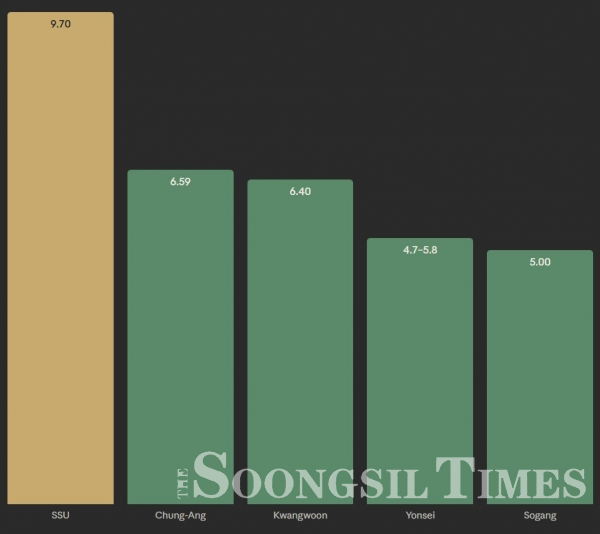
According to an analysis of the number of smoking zones relative to campus area across 34 four-year universities in Seoul, Soongsil University has approximately 9.7 smoking zones per 100,000 m^2. This density is significantly higher than that of ▲Chung-Ang University (approx. 1.1) in the same district or ▲Yonsei University (approx. 1.9), a mission school, and greatly exceeds the overall survey average of 4.32. Considering that even ▲Hanyang University (21) and ▲Yonsei University (20), which have the highest absolute number of smoking zones, have campuses two to seven times larger than ▲Soongsil University, Soongsil University ranks among the top in terms of density. This fact suggests that while smoking accessibility on campus is sufficient, it is simultaneously a campus structure with a high risk of exposure to secondhand smoke. From a statistical standpoint, this implies that the smoking zone issue is difficult to explain by a simple "lack of space."
Interestingly, these figures themselves reflect only a part of reality. As a result of a survey conducted on 34 four-year universities in Seoul, seven universities—▲Sahmyook University, ▲Sungshin Women's University, ▲Dongduk Women's University, ▲Korea National Sport University, ▲Methodist Theological University, ▲Chongshin University, and ▲Seoul Christian University—do not designate a single official smoking zone. However, the fact that there are zero officially designated areas does not mean that smoking does not exist on those campuses. According to a thesis published in the Korean Regional Geography Society (by Sangmyung University researchers So Tae-woo and one other), titled *"A Geographical Study on the Spatial and Behavioral Characteristics of Smoking in Universities: Focusing on the Case of S University in Seoul,"* even in universities without official smoking zones, "implicit smoking zones" that are tacitly accepted among students as actual smoking places are formed. This means that not designating space institutionally does not eliminate smoking behavior; it merely renders the space unofficial and invisible. Paradoxically, this creates a difference: a method like Soongsil University's, which explicitly designates and manages smoking zones, concentrates smoking in specific areas and makes conflicts visible, whereas a method that provides no zones at all potentially disperses conflicts. Either way, it reaffirms that the issue is not a "lack of space," but rather a matter of how the spatial design and usage culture align with each other.
The fact that a statistically high density of smoking zones does not resolve the problem is also confirmed by cases from other universities. Hanyang University ERICA Campus operates a total of 15 smoking zones, yet civil complaints surrounding smoking conditions and the location of smoking zones have consistently occurred, leading to the readjustment of some smoking zones through consultations between related departments. Furthermore, in the case of Kookmin University, despite operating seven designated smoking booths, complaints regarding smoking in non-smoking areas consistently appear on the school community after the start of each semester. In particular, smoking complaints are repeated on transit routes, such as the passage from the Welfare Hall to the Mirae Hall. This demonstrates that the relationship with actual foot traffic and the ventilation structure of the space are more decisive variables than the sheer number of smoking zones.
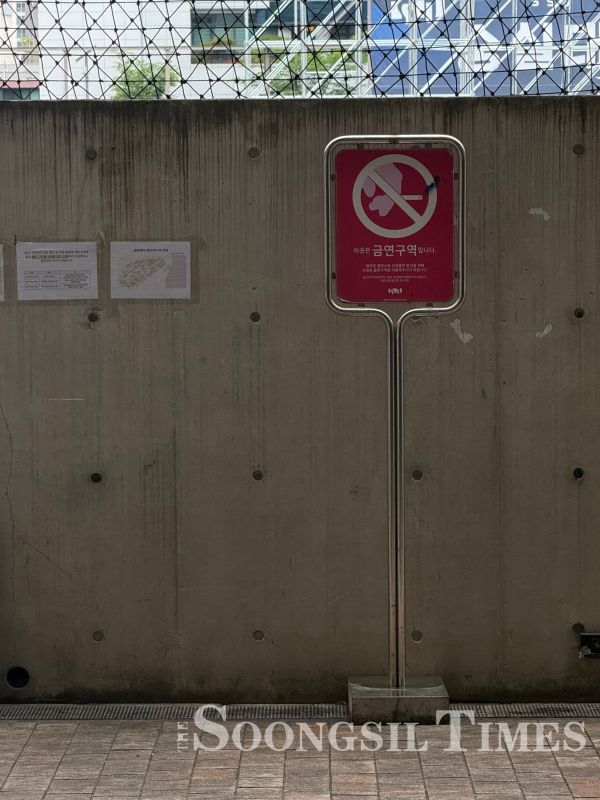
Nevertheless, conflicts are repeatedly occurring in specific spaces. According to survey respondents, the playground-side entrance on the first floor of the Soongsil University Student Union Building is pointed out as a representative problem area. Although the area was reorganized into a non-smoking zone around September 2024, points are continuously raised that smoking still takes place, and smoke spreads throughout the walkway. The area between the back of the Cho Man-sik Memorial Hall and the first floor of the Venture Small Business Hall also draws high dissatisfaction due to poor ventilation, causing smoke to stagnate or drift inside the building. Around the Hyongnam Engineering Hall and the Information Science Hall, amid the perception that the smoking space is narrow compared to the number of students, "habitual smoking" is occurring in blind spots that were converted to non-smoking zones, similar to the entrance of the Student Union Building.
This pattern—where smoking zones exist but fail to function properly due to misalignment with actual transit routes or structural environmental issues—is not confined to Soongsil University. At Kookmin University, there was a case where a smoker admitted, "I thought there were few spaces to smoke near the Mirae Hall, and it was a hassle to go far, so I smoked even though I knew it was a non-smoking area." In the case of Korea University, even though smoking zones were rearranged through a survey and a promotional campaign was conducted led by the student council, instances of smoking beyond the boundaries of official smoking zones or smoking in non-smoking areas are still witnessed. Sungkyunkwan University received positive evaluations after its student council and central committee completely reset smoking zones and ran campaigns through online and offline surveys, but this is also followed by criticisms that the effect is difficult to maintain without continuous management thereafter. Ultimately, the smoking zone issue is not a failure of placement by a specific university, but a complex structure that can only be solved when space, systems, and culture are aligned.
What Are the Respective Positions of Non-Smokers and Smokers?

Smoking in non-smoking areas can hardly be viewed as mere individual deviance. In the survey, to the question "Are there any inconveniences regarding smoking zones?" non-smokers complained, saying, "The streets are thick with smoke," "I repeatedly experience secondhand smoke near smoking zones," and "There are areas where problems repeatedly occur, and I experience too much secondhand smoke." On the other hand, some smokers responded, "Considering the movement paths between buildings, there are times when time constraints arise for smoking." The arguments of both sides hold validity, but the fact that implementing complete separation within a limited campus space is not easy complicates the problem.
In addition, additional bad habits derived from the smoking culture are further intensifying conflicts within the campus. A representative example is the problem of "vaping (e-cigarette smoking)" in indoor spaces, including club rooms. Regardless of whether it is our school or other universities, the act of inhaling e-cigarettes in closed public spaces within college towns is frequently caught. This is interpreted as a result of the erroneous perception that "e-cigarettes produce less smoke and do not leave a lingering odor, so they are different from regular cigarettes." However, this is also clearly indoor smoking and an act that causes secondhand smoke damage. Furthermore, the problem of littering cigarette butts and disposable cups around designated smoking zones is also pointed out as a chronic bad habit. The phenomenon where the surrounding area is polluted with incidental waste despite the provision of a smoking zone clearly shows a lack of community spirit among some smokers. These behaviors not only threaten the health rights of non-smokers but also serve as a major cause of damaging campus aesthetics and sanitation.
Meanwhile, indiscriminate smoking outside designated areas on campus is drawing frowns not only from non-smokers but also among smokers themselves. According to this paper's survey, the majority of smokers also expressed strong disapproval of the behavior of some who break the rules, calling it "selfish behavior that only thinks of one's own convenience" or "thoughtless behavior." In particular, a significant number of respondents agreed that strong regulations against smoking outside designated areas are necessary, which is interpreted as reflecting a sense of crisis that the deviance of a few spreads a negative perception of all smokers and eventually leads to a reduction in smoking rights. Ultimately, for a mature campus culture, internal self-purification efforts, where smokers themselves comply with community rules, must precede simple spatial separation.
Institutional Mechanisms: Are They Effective?
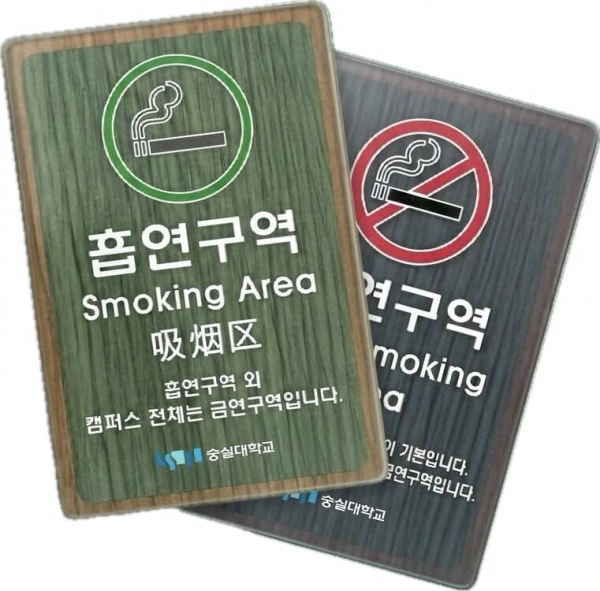
However, it is not that the university has made no effort. Soongsil University explicitly states smoking outside designated places as a ground for disciplinary action through school regulations. In accordance with the National Health Promotion Act, it continuously announces that a fine of up to 100,000 KRW can be imposed for smoking in non-smoking areas on campus. In fact, FOCUSS:U, the 66th Student Council, posted a notice to students last February containing the locations of smoking zones and the possibility of fines for smoking in non-smoking areas. In addition, separate smoking zones and smoking facilities are operated within the school, and the university is continuously expanding facilities or changing locations according to student demand, and providing campus guides and maps so that students can check the locations. As such, institutional and physical mechanisms, such as enacting school regulations, fine provisions, and designating and guiding smoking zones, have been steadily prepared. Nevertheless, a strong perception persists among students that "practical enforcement is not taking place." This suggests that the core of the problem lies not in the absence of regulations or facilities, but in how effectively existing systems are operating on the ground.
The campus smoking zone issue seems to arise not simply from a "lack of smoking zones," but from the entanglement of spatial separation, usage routes, and the effectiveness of regulations. Smoking zones that appear sufficient on paper fail to function if they do not match actual living spheres, and regulations maintained without clear management result in neglecting conflicts rather than mediating them. In a situation where the rights to freedom of smokers and non-smokers clash, it is difficult to find a solution through the concession of only one side. It is time for a realistic and specific contemplation on where and how to set the criteria for coexistence on campus after understanding the interests of both sides.
Seo Soon-oh (ST Cub-Reporter)
sonstaysober@soongsil.ac.kr
Kim Min-ju (Editor-in-Chief)
minjukim900@soongsil.ac.kr