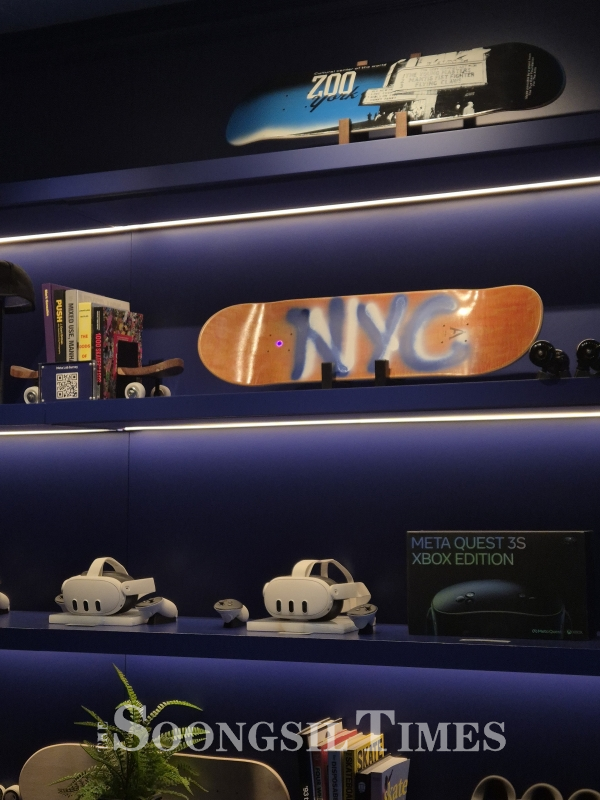
In November 2021, Mark Zuckerberg made an unprecedented announcement. After keeping Facebook as its name for over a decade, the company decided to rebrand to Meta. This decision was mostly to transition from its original identity as a social networking company into a metaverse-based next-generation computing platform. Zuckerberg has consistently shown confidence in the success of metaverse, stating “the metaverse is the next frontier just like social networking was when we got started." Seeming to capitalize on this apparent trend, technology companies invested heavily in services such as virtual meeting rooms, digital offices, and virtual concerts. The public imagined a future resembling that depicted in Ready Player One (2018). The metaverse seemed to be at its peak.
However, contrary to public expectations, the metaverse frenzy was short-lived. Horizon Worlds, Meta’s flagship service, was widely ridiculed for its poor quality, with screenshots of the game even turning into online memes. Furthermore, despite investing tens of billions of dollars into Reality Labs every year, the research unit continued to suffer substantial operating losses. Because Horizon Worlds failed to secure its target user base, Meta eventually announced in March 2026 that it would be closing its virtual reality(VR) services and transitioning to a mobile- and web-based service, effective June 2026. The media criticized this endeavor as “the costliest flop of all time.”
In fairness, the reason why the metaverse could not succeed is simple. First, the technology of the time fell short of expectations. Since the objective of the metaverse was to create a space realistic enough to replace reality, it hinges on the premise that users are fully immersed in the experience. However, due to limitations in graphics, avatars appeared without limbs, and user actions suffered input delay. Heavy headsets such as Oculus Quest 2 constricted movement, further contributing to user fatigue. Such problems resulted in customer churn, and since the metaverse relies heavily on social interaction, it triggered a negative feedback loop: less users meant less appeal.
Does this mean the future of the VR industry is over?
Not necessarily. Although the metaverse failed to meet the public’s expectations, the spatial computing industry is still growing rapidly. Spatial computing is a technology which overlays digital information onto physical space, allowing users to intuitively interact with the information. It encompasses VR, augmented reality(AR), computer vision, sensor technology, and wearable devices. One of the biggest differences in the way users interact with technology in the current spatial computing wave is that they can operate more passively in the background. Traditional VR required a separate digital environment, which forced users to disconnect from the physical world and take time to adapt to the new environment. In contrast, new AR makes the technology less disruptive to everyday life and gives a more practical purpose.
Popular culture has illustrated similar concepts that spatial computing is now beginning to make possible. In Marvel’s Avengers: Endgame (2019), Tony Stark invents time travel by manipulating interactive 3D holograms with his hands. Similarly, E.D.I.T.H., the AI glasses worn by Peter Parker in Spider-Man: Far From Home (2019), are another example of AI integrated with spatial computing. As the film industry is reimagining the future, the technology industry is now beginning to catch up.

Such trend is also evident in Meta’s recent strategic direction. While Meta still continues to develop VR devices through its Quest series, it is also exploring other means of AR, especially prioritizing smart glasses. One notable example is the Meta Ray-Ban Display, co-developed by Meta and EssilorLuxottica. Equipped with a camera, speaker, microphone, and generative AI, the glasses allow users to take photos or play music only using their voice. Users can also ask questions about their surroundings or request real-time translation, to which the generative AI assistant will respond. The user can visually witness the response process through their glasses screen.
The spatial computing industry is shifting from replacing reality to naturally integrating digital space with reality. This gives AR a much better chance of mass adoption than the metaverse, since it provides practicality making it more likely to target a bigger consumer base. While the metaverse mostly focused on video games and the entertainment industry, AR can extend to more markets such as health, productivity, and education. This makes spatial computing less of a separate entertainment experience and more of an extension of technology that more people can use. AR can blend into the way people naturally interact with the world.
Furthermore, AI has the potential to make that integration more powerful. While previous devices primarily focused on displaying digital information, AI allows these devices to understand and respond to their surroundings in real time. As seen in the Meta Ray-Ban Display, generative AI can interpret the information through cameras and sensors, and respond through voice or visual interfaces. This is a more intuitive form of user interaction since users do not necessarily need to manually navigate menus or search for a specific feature. Instead, they can simply ask the device a question about what they see or request assistance. In this sense, AI could assist spatial computing in changing the paradigm of user experience. Although the metaverse failed because companies tried to completely substitute reality with virtual environments, the next generation of AR-based spatial computing will focus on embedding digital information into our everyday lives.
Jung Ah-in(ST Reporter)
ahinjung@soongsil.ac.kr