In April 2026, Kia announced that it would invest an additional $600 million to build electric vehicle production lines at its plant in Pesqueria, Nuevo Leon, Mexico. But according to industry sources, at around the same time, Hyundai Motor invested $12.6 billion to build and is now operating Metaplant America in Georgia, in the U.S.. Same group, same industry—but one chose Mexico, and the other chose the U.S. mainland. In fact, both decisions started from the same question. How do you prepare a way to keep production going even if one location is shaken? This is now the core of the global supply chain restructuring under way.
This trend is often explained as “decoupling from China” or “relocating production bases,” but these terms do not accurately describe the change. Kia did not give up on the U.S. to go to Mexico, and Hyundai did not shut down its Mexican production either. Instead of replacing one base with another, companies are simultaneously expanding production bases that each play a different role. Supply chains have not moved—they have been divided. The strategy has shifted from an era of searching for the single most efficient answer to an era of preparing multiple answers.
Why Did Efficiency Become a Risk?
For the past 30 or so years, the goal of global supply chains was to gather production in one place and cut costs. As China’s labor force, supplier networks, and logistics grew stronger, it became known as the “world’s factory.” And the more companies concentrated their production there, the cheaper they could make their products. But the pandemic showed that when production is concentrated in a single country like China, one factory stopping can disrupt production worldwide. So supply chains began to be redesigned—not for the most efficient structure, but for a structure that can hold up even in a crisis.
Not Replacement, But Addition
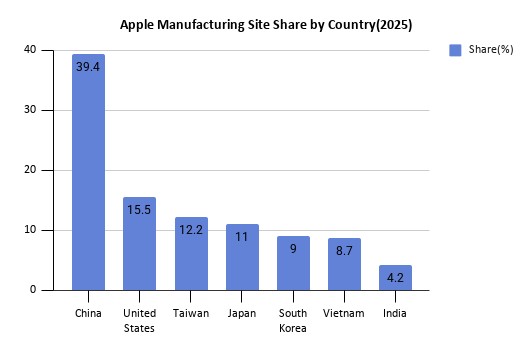
This change is also clear in Apple’s supply chain. Reports that “Apple is leaving China” have repeated every year, but in reality, Apple has not abandoned China—it has, rather, added more options outside China. A large share of iPhone production still takes place in China, and a manufacturing ecosystem packed with thousands of parts suppliers and skilled workers is hard to move in a short time. Instead, Apple has added new production axes on top of its China base, one by one. According to foreign media reports, Apple has rapidly expanded the share of iPhone assembly in India, while Vietnam has grown into a key production base for AirPods, iPads, and the Apple Watch. Apple did not replace China—it changed the way it depends on China. So the core of supply chain restructuring lies not in relocation, but in diversification.
Each Base Now Has a Different Role
Even in this era of dispersed supply chains, each base takes on a different role. Vietnam functions more like “insurance” against relying too heavily on China. It has grown quickly on the strength of low labor costs and Free Trade Agreements, and according to Samsung Electronics, its six factories in Vietnam produce more than half of all smartphones sold worldwide. Mexico, on the other hand, has become a production base for the North American market, built on its border with the U.S. and the tariff benefits under the U.S.-Mexico-Canada Agreement(USMCA). If Vietnam is a choice made to spread out risk, Mexico is a choice made to close the distance to the market.
But this division of roles did not stay safe for long. As time passed, the U.S. began to ask, “Is this base really independent of China?” According to Reuters and other foreign media reports, in July 2025 the U.S. imposed a two-tier tariff: 20% on Vietnamese-made products, and 40% on goods judged to be transshipped, under suspicion that some exports were Chinese capital and parts with only the country of origin changed. In July 2026, the U.S. began a joint review of the USMCA and applied the same standard to Mexico. Both countries had risen as alternatives to China, only to end up having to prove how connected they still were to it.
The reason this pattern keeps repeating is simple. Spreading out a supply chain does not eliminate risk itself. It only moves the location of the risk. Yesterday’s alternative becomes today’s suspect, and today’s alternative can face the same test tomorrow. So supply chain restructuring is not something that ends with a single decision. It has become an ongoing process of having to prove itself again and again.
The Challenge Facing Korean Companies
The intensity of regulation differs by industry. Samsung Electronics keeps expanding its production capacity in Vietnam, but in an industry like semiconductors, where technology and security are directly linked, U.S. restrictions on bringing in equipment have themselves become a variable that determines the fate of the supply chain. This raises the same question for Korea’s economy as well. Korea is a country that produces intermediate goods—semiconductors, batteries, auto parts—and supplies them to assembly plants around the world. Standing at the center of a supply chain that connects many countries used to be a strength, but now that supply chains themselves have become a matter of politics and security, that same position also means Korean companies can be exposed to the regulations and conflicts of several countries at once.
So what Korean companies need is not to find a single perfect production site, but to prepare, in advance, alternative routes that can hold up even if one location is blocked. Specifically, they need to build a system that can trace, on its own, where components and raw materials came from and what route they traveled. A company that has to explain itself after the fact over transshipment or origin problems cannot have the same negotiating power as a company that can answer with data in advance. At the same time, companies need the flexibility to run several alternatives at once, rather than fixing production at a single site. This is because, instead of building a new factory every time regulations change, they need to already be running multiple bases and be able to adjust the weight given to each as needed. In the end, the competitiveness of Korean companies going forward will be decided not by where they produce, but by how quickly they can change their structure and how transparently they can explain it.
Globalization is no longer a matter of finding the single cheapest place and concentrating production there—it has changed into a way of connecting multiple bases to spread out risk. In an era where today’s alternative becomes tomorrow’s risk, a company’s competitiveness depends not on having one perfect supply chain, but on having several supply chains that will not collapse together.
Lee Chae-young(ST Reporter)
codud@soongsil.ac.kr